


Abandoned carts are one of the biggest revenue leaks in eCommerce. About 7 out of 10 shoppers who add something to their cart never finish checking out — and on mobile, that number climbs even higher.
We’ve worked with hundreds of online stores, and we’ve seen how frustrating this can be. The good news? With the right strategies, you can win back many of those lost sales.
Here are 12 proven tactics to recover those abandoned carts and boost your revenue:
In This Article:
- Cart Abandonment: A Growing Problem That's Costing You Money
- How to Enable eCommerce Tracking in WordPress
- 12 Ways to Reduce Shopping Cart Abandonment
- 1. Track Shopping Cart Abandonment
- 2. Speed Up Your Site
- 3. Make Navigation from Shop to Cart Convenient
- 4. Determine if Abandoners Are Returning
- 5. Add Reassuring Copy
- 6. Offer Free Shipping
- 7. Display Popular Products
- 8. Build Trust With Security Badges & Social Proof
- 9. Offer Guest Checkout
- 10. Use Remarketing to Target Abandoners
- 11. Exit Intent Popup
- 12. Send Emails Reminding About Shopping Cart Abandonment
- Frequently Asked Questions About Shopping Cart Abandonment
- Bonus: Resources to Boost eCommerce Performance
Cart Abandonment: A Growing Problem That’s Costing You Money
The numbers put it in perspective. Cart abandonment rates vary significantly by industry — in some sectors, more than 8 out of 10 shoppers never complete a purchase. Here’s how it breaks down across common verticals:
- Luxury & Jewelry: 82.84% (highest abandonment rate)
- Home & Furniture: 80%+
- Beauty & Personal Care: 80%+
- Multi-Brand Retail: 76.90%
- Footwear: 78.53%
- Consumer Goods: 57.37% (lowest abandonment rate)
- Pet Care & Veterinary Services: 54.78% (surprisingly low due to essential nature)
The financial impact is real. Research from the Baymard Institute estimates that $260 billion worth of lost orders are recoverable through better checkout optimization alone.
If you’re currently making $15,000 per month and could convert just 25% of your abandoned carts, that’s an additional $45,000 in annual revenue.
According to the Baymard Institute, the top reasons shoppers leave before completing checkout are:
- 39% abandon due to high extra costs (shipping, taxes, fees)
- 26% don’t want to create an account
- 19% don’t trust the site with their credit card information
- 23% cite slow delivery times
- 22% find the checkout process too long or complicated
Before implementing any of these tactics, set up proper tracking so you have a baseline to measure your improvements against.
How to Enable eCommerce Tracking in WordPress
MonsterInsights is the best Google Analytics plugin for WordPress. It provides detailed reports right on your dashboard, and makes setting up eCommerce tracking a breeze. No coding required!

To use the eCommerce tracking feature, you’ll need to purchase MonsterInsights at the Pro level.
For a step-by-step setup walkthrough, check out our eCommerce tracking tutorial for WordPress.
12 Ways to Reduce Shopping Cart Abandonment
1. Track Shopping Cart Abandonment
Before implementing any tactic, you need a baseline. A custom funnel report in GA4 gives you a real-time view of where customers are dropping off — and once you build it, it runs automatically.
For the full setup walkthrough, see our guide to tracking cart abandonment in Google Analytics.

In addition to your overall cart abandonment rate, MonsterInsights’ eCommerce addon provides product-level data you can’t get from GA4 alone.
The Cart Abandonment report shows you exactly which products are being abandoned at the highest rate — so you know where to focus first.

See Exactly Which Products Your Customers Are Abandoning
MonsterInsights’ eCommerce addon shows you product-level cart abandonment data right in your WordPress dashboard — so you know which items to prioritize, not just your overall abandonment rate.
Get MonsterInsights Pro2. Speed Up Your Site
Slow sites cost you sales. Shoppers have zero patience for a sluggish checkout experience — and for mobile users on slower connections, even a one-second delay can be enough to send them elsewhere.
Site speed has a direct impact on whether shoppers complete a purchase. Research from Google consistently shows that as page load time increases, the probability of a visitor dropping off rises sharply. Under 3 seconds is a solid baseline target for most stores.
To test your website speed, open your MonsterInsights dashboard and navigate to Insights » Reports » Site Speed.
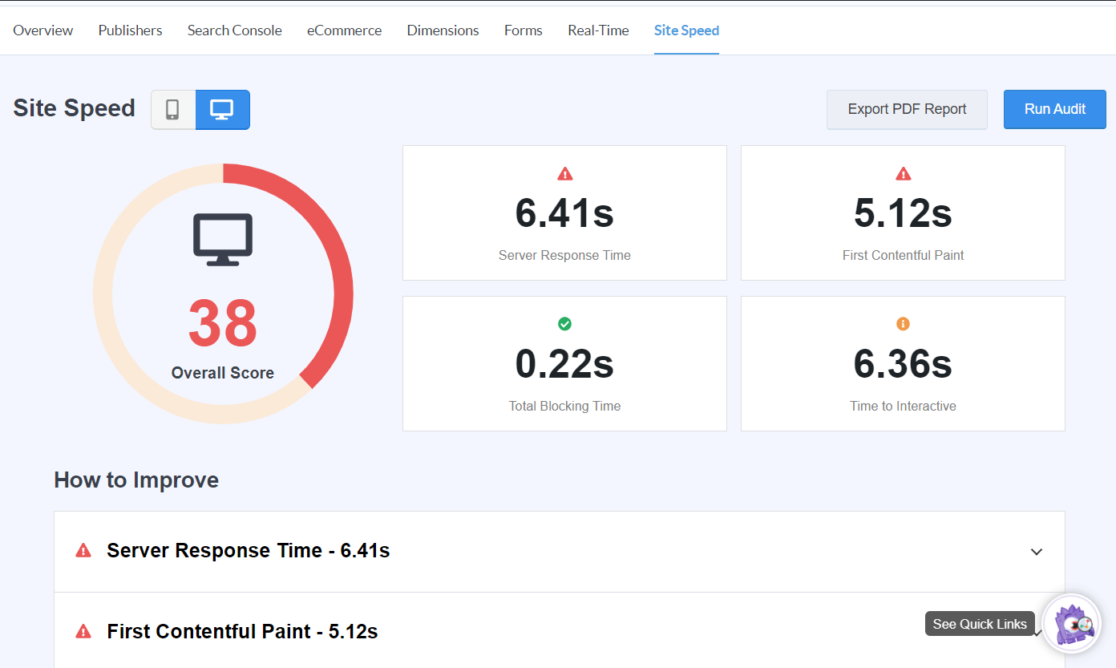
Here, you’ll see your overall score, loading time in seconds, and a “How to Improve” section for your developer to use. You can toggle between mobile and desktop speed in the upper left.
Share the “How to Improve” section with your developer — it gives them specific, prioritized recommendations for shaving off load time. For a deeper look at performance optimization, our WordPress speed optimization guide covers the highest-impact fixes.
3. Make Navigation from Shop to Cart Convenient
The easier you make it for customers to navigate between the shop and the cart, the more likely they are to stick with it and actually check out.
Here are a few changes that make a real difference:
- Review the path exploration report to identify where customers are dropping off, then address those friction points directly.
- Don’t force shoppers to hit the back button after adding a product to their cart — offer a “continue shopping” option or take them straight to the cart.
- Keep the cart visible on every page so customers can return to it whenever they’re ready to complete the purchase.
Small friction points — like requiring shoppers to hunt for their cart — add up fast. Removing them costs nothing and often delivers an immediate lift in completions.
4. Determine if Abandoners Are Returning
Sometimes, people will leave your site and abandon their cart, but return at a later date to finish checkout.
To see if that’s the case, open your MonsterInsights dashboard and head to the Insights » User Journey tab to see your User Journey report:

Don’t have the User Journey report yet? Here’s how to set it up in MonsterInsights.
To see individual reports, click on the Transaction ID. There, you can see if a user abandoned their cart, then returned later to complete their purchase.

Look for patterns in these return visits — what pages did they view on the way back? How long did they take? Those details tell you what’s working and where to optimize next.
5. Add Reassuring Copy
Reassuring copy at checkout is one of the most underrated fixes for anxiety-driven abandonment.
For instance, Groupon adds a Frequently Asked Questions section alongside a customer promise at the bottom of their checkout page — giving hesitant shoppers the clarity they need to complete the order.

You don’t need a full redesign to make this work. Even a single line — “Free returns within 30 days” or “Your payment is encrypted and secure” — can ease the hesitation that pushes shoppers away at the last step.
6. Offer Free Shipping
Free shipping is everywhere, so your customers will likely expect it on your site as well.
According to the Baymard Institute, 39% of shoppers who abandon their carts do so because of extra costs — with shipping fees being the biggest driver. Without a free shipping offer or a clear threshold, you’re handing a meaningful portion of your shoppers a reason to leave.
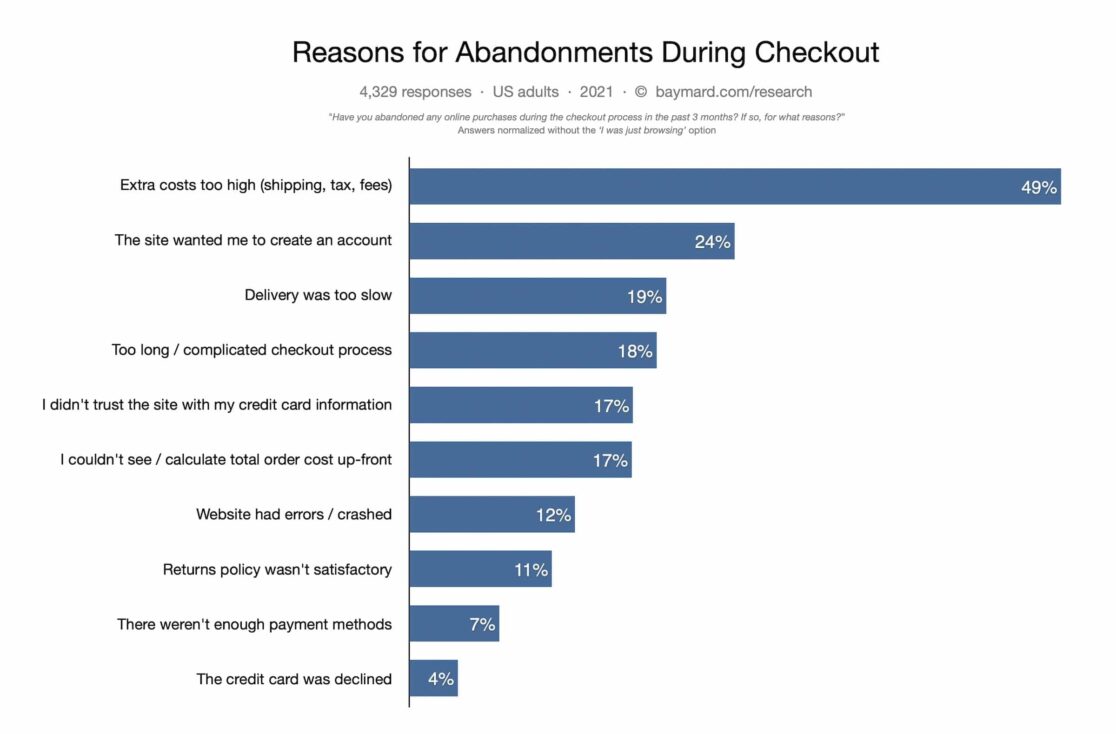
But what if offering free shipping is not profitable for your business?
In that case, set a free shipping threshold instead.
Setting your threshold just above your average order value works well. It reduces cart abandonment and gives customers a natural incentive to add one more item to hit the free shipping mark — which also bumps your AOV.
To find your Average Order Value, open your MonsterInsights eCommerce report dashboard:

Find Your Average Order Value — Right in WordPress
Your AOV is the key number for setting your free shipping threshold correctly. MonsterInsights pulls this directly from GA4 into your WordPress dashboard — no spreadsheets, no extra setup needed.
Track Your Store Performance7. Display Popular Products
Showing your most popular products gives new visitors a confidence boost — they can see what other shoppers are buying, which takes some of the guesswork out of browsing. It also increases your average order value and makes your store easier to navigate.
To create a popular products widget, open your MonsterInsights dashboard and head to Insights » Popular Posts, then click the Popular Products tab in the top navigation.

From here, you can choose your design, filter out categories you don’t want to display, set layout options, and decide where the widget appears. Choose “Automatic Placement” to let MonsterInsights add the widget to your pages without any additional setup.
Once it’s live, it runs automatically — no ongoing maintenance required.
For configuration tips, see our guide to displaying best-selling products in WooCommerce.
8. Build Trust With Security Badges & Social Proof
Research from the Baymard Institute shows that 19% of shoppers abandoned because they didn’t trust the site with their credit card information. When customers shop at your store, they want reassurance that their payment details are safe.
Adding a security badge to your checkout page is one of the easiest ways to build that trust. It signals to shoppers that their data is protected — and for a hesitant buyer, that signal often makes the difference.
According to research by Baymard Institute, the SSL seal from Norton is among the most recognized by shoppers — though any well-known badge from a reputable security provider will carry weight.
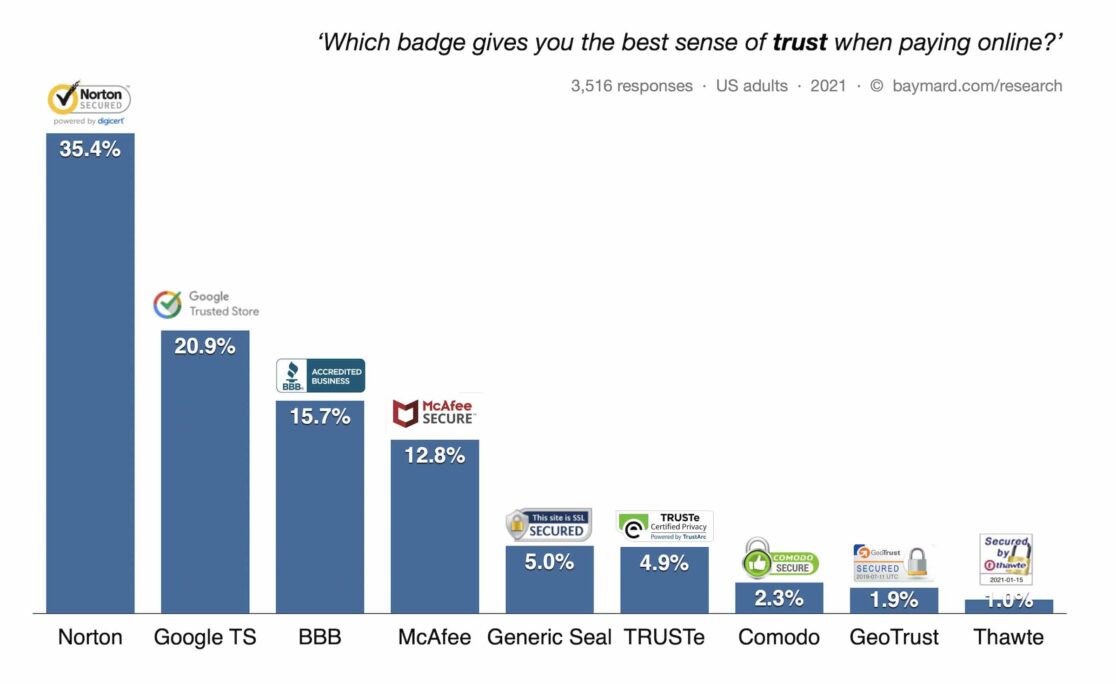
In addition to badges, you can add social proof by showing that others are buying on your site right now. TrustPulse displays a small popup in the corner of your site whenever someone makes a purchase — a subtle nudge that tells hesitant shoppers someone else just bought what they’re looking at.
9. Offer Guest Checkout
Enticing your customers to create an account on your site is a great strategy for customer retention. It also helps you gather more data about your visitors, so you can curate a personalized user experience for each individual based on the data you have.
That said, forcing customers to create an account before checkout can push them away at the worst possible moment. A guest checkout option removes that barrier — customers can complete their order quickly, and you can invite them to create an account afterward, once they’ve already made their purchase.
If you want to track the behavior of logged-in customers separately, you’ll need custom dimensions set up in Google Analytics to capture user-level data.
10. Use Remarketing to Target Abandoners
Remarketing is a cost-effective advertising method that lets you show customized ads to people who recently visited your site but left without buying.
You can run remarketing campaigns across social networks and display networks, showing abandoners a reminder about the item they left behind. To target shoppers more precisely across different channels, it also helps to collect demographics and interests data on your site — see our docs on enabling the demographics and interests report in Google Analytics.
If you’d rather reach abandoners without a paid ad budget, push notifications are worth adding to the mix. PushEngage has pre-built WooCommerce cart abandonment sequences that fire automatically when a subscriber leaves without buying — no email address required, and no ad spend needed.
11. Exit Intent Popup
We’ve seen that remarketing helps you reach abandoned customers across different channels. Even so, display campaigns require an ad budget and setup time before they reach anyone.
There’s a more direct option: target abandoners on your site right as they’re leaving. With an exit intent popup, you can trigger a customized offer the moment someone moves to close the tab or navigate away.

OptinMonster, a leading opt-in form builder and WordPress popup plugin, makes it straightforward to set up exit intent campaigns — and it’s generally faster to launch than a full remarketing campaign.
12. Send Emails Reminding About Shopping Cart Abandonment
An abandoned cart email is a personalized message that reminds shoppers about their incomplete order and nudges them to come back. When implemented well, an email remarketing campaign can meaningfully reduce your abandonment rate and win back customers who were ready to buy.
A well-designed abandoned cart email sequence focuses on the reminder first — not the discount. Notice how the subject lines in the example below center on the item left behind, and the CTA points directly back to the cart:

The subject lines focus on the item left behind, and the CTA points directly back to the cart. That’s the formula: reminder first, friction removed, clear path to purchase.
GA4 lets you scale and measure the ROI of your entire email sequence — see our guide to tracking email campaign performance in Google Analytics. And for a broader set of recovery options, our guide to abandoned cart recovery strategies covers the full toolkit.
Timing Is Everything
Your first abandoned cart email should go out within 2–4 hours of abandonment. Purchase intent drops fast after someone leaves, and the longer you wait, the more likely the moment has passed. Get that first email in their inbox while your store is still top of mind — then follow up if needed.
Frequently Asked Questions About Shopping Cart Abandonment
Here are some frequently asked questions about shopping cart abandonment.
Which abandonment strategy should I implement first if I’m just starting?
I always recommend starting with the fundamentals: ensure your site loads in under 3 seconds, add trust badges to your checkout page, and implement basic abandoned cart email tracking. These three changes typically provide the biggest immediate impact with minimal investment. Once you have baseline tracking in place with tools like MonsterInsights, you can identify your specific problem areas and prioritize accordingly.
How long should I wait before sending my first abandoned cart recovery email?
I recommend sending the first email within 2–4 hours of cart abandonment. Emails sent within this window consistently outperform those sent later by a significant margin, because purchase intent is still fresh. The goal is striking while the memory of the item is still top of mind — but allowing enough time for the customer to potentially return on their own first.
Should I always offer discounts in my abandoned cart recovery campaigns?
No — and this is a common mistake. Start with simple reminders before resorting to discounts. Many customers will return without any incentive if you remind them effectively, especially if they abandoned due to distraction rather than price concerns. Reserve discounts for your final email in the sequence (after 72 hours) or for high-value customers. Overusing discounts can actually train customers to abandon carts on purpose, expecting a deal to follow.
What’s a realistic timeline to see results from cart abandonment strategies?
In my experience, you can expect to see initial improvements within 2–4 weeks of implementing basic strategies like exit-intent popups and simplified checkout. More significant results from email campaigns and comprehensive optimization typically show within 6–8 weeks. The biggest gains come from systematic implementation over 2–3 months rather than trying to fix everything at once.
Is it possible to reduce cart abandonment to zero?
Not realistically, and you shouldn’t aim for zero. A significant portion of cart additions happen because people are just browsing — they were never serious buyers. A healthy abandonment rate for most industries falls between 50–65%. Focus on converting the recoverable abandoners rather than chasing an impossible zero rate. The goal is optimization, not perfection.
Bonus: Resources to Boost eCommerce Performance
Once you’ve implemented these cart abandonment strategies, you’ll want to dive deeper into eCommerce optimization and analytics. Here are the essential guides I recommend to help you maximize your store’s potential:
- Complete Guide to eCommerce Tracking in Google Analytics – Set up comprehensive tracking for revenue, conversions, and customer behavior analysis
- How to Find Your Average Order Value in Google Analytics – Find and monitor the key metric behind your free shipping threshold strategy
- User Journey Tracking: See How Customers Navigate Your Store – Understand the complete path customers take from first visit to purchase
- Email Marketing Campaign Tracking in Google Analytics – Measure the ROI of your abandoned cart email campaigns and other email marketing efforts
- Top eCommerce Metrics & KPIs to Track in Google Analytics 4 – The numbers that actually matter for measuring and growing your store’s performance
- Crucial eCommerce Growth Strategies – Comprehensive tactics to grow your online store beyond just reducing abandonment
Is your store built on WooCommerce? Our WooCommerce conversion tracking guide is worth bookmarking too.
Follow us on X, Facebook and YouTube for more helpful marketing guides and Google Analytics tips and tutorials.