


GA4 tracks nearly every interaction on your site — but knowing which events actually matter, and what to do with them, is a different problem entirely.
Event tracking is one of the most powerful features in Google Analytics 4. It’s also one of the most misunderstood. Most beginners see a long list of event names in their reports and have no idea what they’re looking at or why it matters to their business.
I’ll break down exactly what Google Analytics events are, the four types you’ll encounter, how to read your event data, what event count means, and how to set up event tracking on your WordPress site without touching a line of code.
In This Article:
- What Are Google Analytics Events?
- What Is Event Count in Google Analytics?
- How to View Google Analytics Events in GA4
- Google Analytics Events vs. Conversions
- What Are Google Analytics Event Parameters?
- How to Set Up Google Analytics Event Tracking in WordPress
- Video Tutorial: Google Analytics Events
- FAQs About Google Analytics Events
What Are Google Analytics Events?
A Google Analytics event is any user interaction on your website or app that GA4 tracks independently of a pageview. While a pageview fires every time someone loads a page, events capture everything else — a button click, a video play, a file download, a form submission, a scroll milestone.
In practice, every single session generates multiple events. When a visitor lands on your site, GA4 fires a session_start event and a page_view event. If they navigate to another page, another page_view fires. If GA4 has no record of that visitor before, it also fires a first_visit event.
That’s just the baseline. GA4 is capable of tracking dozens of other interactions, depending on what you’ve enabled and set up.
There are four categories of events in Google Analytics 4. Understanding the difference between them makes everything else click:
- Automatically Collected Events — Tracked out of the box with no setup required. Examples include
page_view,session_start, user_engagement, andfirst_visit. - Enhanced Measurement Events — Optional events built into GA4 that you activate with a toggle. They include outbound link clicks, site search, scroll depth, video engagement, and file downloads.
- Recommended Events — Predefined events Google suggests you implement for your site type. Most are eCommerce-focused:
add_to_cart,purchase,begin_checkout, and more. - Custom Events — Events you define yourself, built around interactions unique to your site. These require manual setup via Google Tag Manager or code.
The first two categories are where most WordPress site owners spend their time. Automatically collected events are already running — you just need to know how to read them. Enhanced Measurement events are opt-in but can be switched on in a few clicks.
What Are GA4 Enhanced Measurement Events?
Enhanced Measurement is GA4’s built-in layer of tracking beyond standard pageviews. The idea: most sites want to track the same common interactions, so Google built them in as toggles rather than requiring custom code for each one.
When you turn Enhanced Measurement on, GA4 will automatically track:
- Scroll depth — fires when a user reaches 90% of a page’s length
- Outbound clicks — tracks clicks to external domains
- Site search — records what visitors type in your search bar
- Video engagement — tracks YouTube video plays, progress, and completion (embedded YouTube only)
- File downloads — fires when a visitor clicks a link to a common file type (PDF, ZIP, DOCX, etc.)
- Form interactions — fires on form starts and submissions
You’ll find the Enhanced Measurement settings inside your GA4 property under Admin » Data Streams, then click your web data stream and look for the Enhanced Measurement toggle.

A few things worth knowing about Enhanced Measurement’s limitations: scroll depth only fires at 90% — there’s no data on users who stopped at 25%, 50%, or 75%. Form tracking can be inconsistent across different form builders. And video engagement only works for embedded YouTube videos, not Vimeo or HTML5. For a deeper look, the GA4 Enhanced Measurement guide covers what each toggle actually captures and where the gaps are.
What Are Recommended Events in GA4?
Recommended events are events Google has predefined and named — but they don’t come set up out of the box. You implement them manually (typically via Google Tag Manager) when they apply to your site type.
The most commonly used recommended events are eCommerce events like add_to_cart, begin_checkout, purchase, and refund. There are also events for sign-ups, tutorial completions, and content sharing. Gaming sites have their own dedicated list.
The reason Google recommends specific names — rather than letting everyone invent their own — is consistency. If everyone calls the same event purchase, Google’s reporting and benchmarking tools work better. Using custom event names for things Google already has a recommended name for creates unnecessary complexity.
That said, setting these up manually in GA4 is a non-trivial task. If you run a WooCommerce store on WordPress, there’s a much easier path — more on that in the tracking setup section below.
The Four Types at a Glance
Automatically collected and Enhanced Measurement events are the most accessible for beginners — no coding required. Recommended and custom events require manual setup, but tools like MonsterInsights handle the most common ones automatically for WordPress sites.
What Is Event Count in Google Analytics?
Event count is the total number of times a specific event has fired within a given time period. If 100 visitors each scrolled to the bottom of a page, the scroll event count would be 100. If one visitor clicked a download link three times, that’s a count of 3 for the file_download event.
Event count is a cumulative total — it counts every trigger, not just unique users. This is an important distinction. A page with an event count of 500 for video_start doesn’t mean 500 different people watched a video; it means the event fired 500 times across all sessions.
In your GA4 Events report (under Reports » Engagement » Events), you’ll see each event listed with its event count alongside two other key columns:
- Event count — total number of times the event fired
- Total users — how many unique users triggered the event at least once
- Event count per user — the average number of times each user triggered it
Comparing event count to total users is one of the quickest ways to spot engagement patterns. A high event count relative to users means people are triggering the same event repeatedly — useful for understanding repeat interactions like clicks on a navigation element or multiple video plays per session.
For most site owners, event count is most meaningful when you’re analyzing which events happen most and whether your key actions (purchases, form fills, downloads) are being triggered at the rate you’d expect. A sudden drop in event count for a critical event — like purchase — is often the first signal that something is broken in your funnel.
How to View Google Analytics Events in GA4
GA4 surfaces your event data in the Events report, which is one of the more useful standard reports in the interface. Here’s how to get there and what you’ll see.
Step 1: Log in to Google Analytics and select your GA4 property.
Step 2: In the left sidebar, go to Reports » Engagement » Events.
Step 3: The Events report shows a list of every event that has fired on your site, ranked by event count. Each row shows the event name, total event count, total users, and event count per user.

Step 4: Click any event name to drill into it. You’ll see a breakdown of the event by date, and you can use the dimension picker to segment the data by country, device category, or other dimensions.
Step 5: To see event parameters — the additional data attached to each event — you’ll need to use Explore (the free-form exploration tool). In Explore, add the event parameter as a dimension. For example, adding page_location as a dimension alongside scroll events shows you which pages people are scrolling the deepest on.
One limitation of the standard Events report: it doesn’t show parameters inline. For richer analysis — filtering by parameter, building funnels, or segmenting by device — you’ll use the Explore section. Our guide to building custom GA4 reports walks through that in detail.
Google Analytics Events vs. Conversions
Every conversion in GA4 is an event — but not every event is a conversion. The distinction matters for how you measure your site’s success.
Events capture everything happening on your site: page loads, scrolls, video plays, clicks, downloads. The list is long, and most of those interactions are interesting context — but they’re not the goal. Conversions (called “key events” in GA4) are the small subset of events that actually tell you whether your site is doing its job.
To track conversions in GA4, you mark any existing event as a key event by toggling the switch next to its name in Admin » Events. From that point forward, GA4 starts tracking conversion rate and conversion count alongside your standard reports.
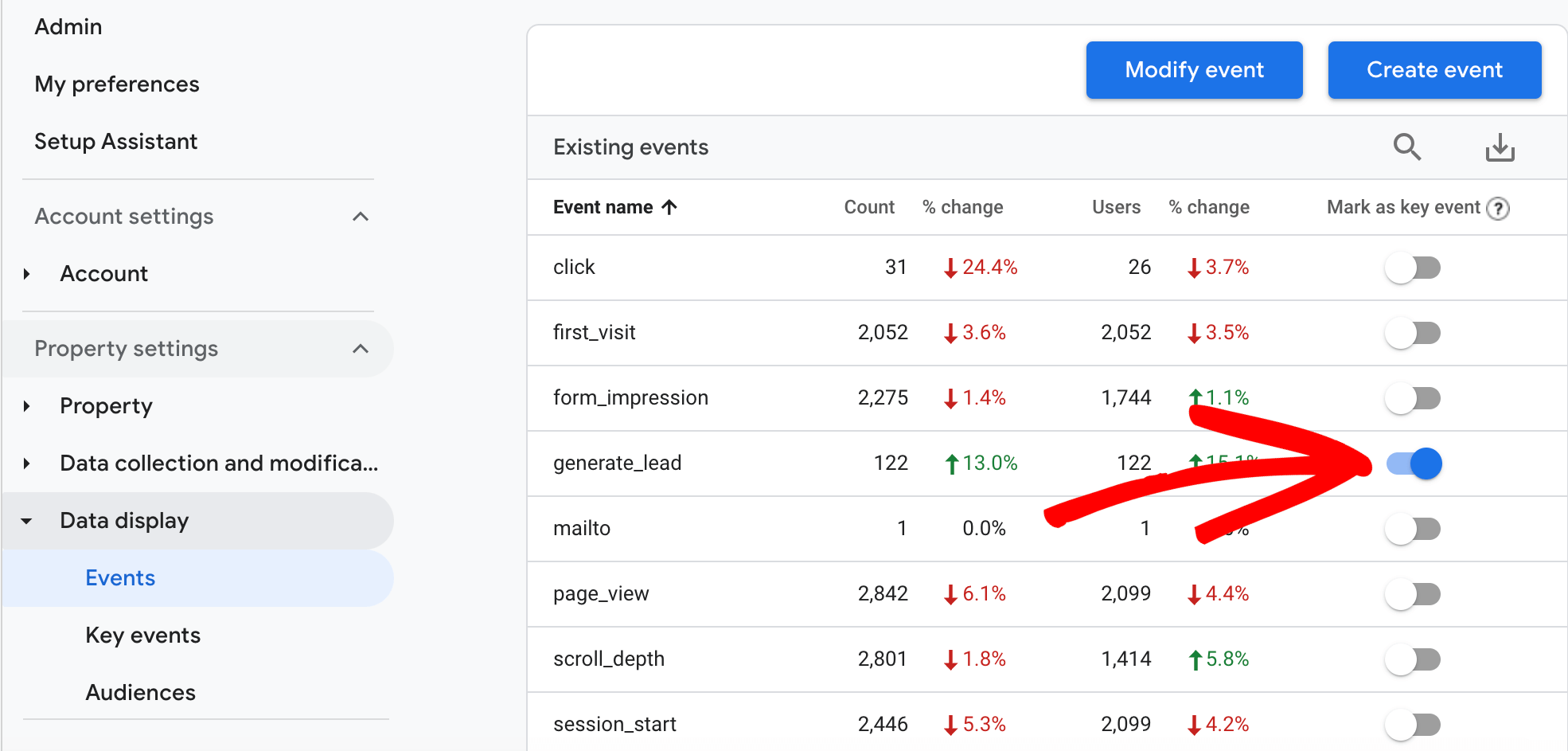
Which events should you mark as key events? I’d start with the two or three actions that most directly represent a “win” on your site: a completed purchase, a form submission, a specific page view (like a /thank-you/ page), or a file download. For most sites, three to five key events is the right number — enough to measure what matters, not so many that the data gets noisy.
Once your key events are set, GA4 starts attributing them to traffic sources. That’s where conversion data gets genuinely useful: you can see not just how many conversions happened, but which channels, campaigns, or landing pages are driving them.
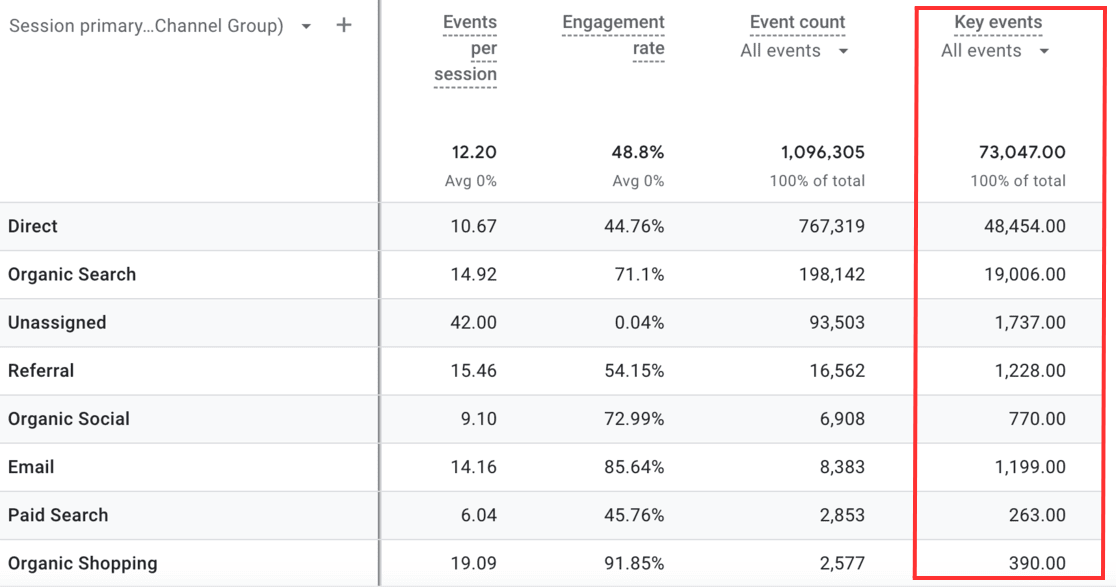
The GA4 conversion tracking guide above walks through everything from marking events to reading the resulting reports for your WordPress site.
What Are Google Analytics Event Parameters?
An event parameter is extra data that gets sent along with an event when it fires. If an event is the “what” (a scroll happened), parameters are the “how” and “where” (scroll depth was 90%, on the /pricing/ page).
Every GA4 event can carry up to 25 parameters. Some are set automatically by GA4, some come with Enhanced Measurement events, and others you add yourself for custom tracking needs.
Here are some of the most commonly used parameters, with examples of what they capture:
- page_location — the full URL where the event fired
- page_title — the title of the page
- file_name — the name of a downloaded file (sent with
file_downloadevents) - link_url — the URL of an outbound link that was clicked
- percent_scrolled — how far down the page a user scrolled (sent with
scrollevents) - value and currency — monetary amount and currency for purchase events
- transaction_id — unique identifier for eCommerce purchases
The challenge with parameters in GA4 is that they don’t surface automatically in standard reports. To use a parameter as a filter or dimension in your reports, you need to first register it as a “custom dimension” under Admin » Custom definitions. This is a one-time setup per parameter, and it only starts applying to data collected after you register it.
For most site owners, the default parameters attached to Enhanced Measurement events are enough to start. The need for custom parameters grows as your tracking needs get more specific — tracking a coupon code applied during checkout, for example, or the specific category of a downloaded resource.
How to Set Up Google Analytics Event Tracking in WordPress
If your site runs on WordPress, you don’t need to touch GA4’s settings interface, write custom JavaScript, or configure Google Tag Manager just to get solid event tracking in place. MonsterInsights, the WordPress analytics plugin, handles the most important events automatically — and shows you the data right inside your WordPress dashboard.
Here’s what MonsterInsights tracks automatically the moment it’s installed and connected to GA4, with no configuration required:
- Scroll depth at 25%, 50%, 75%, and 100% — four data points instead of GA4’s single 90% threshold, giving you a real picture of how far visitors read your content
- Outbound link clicks — including cloaked affiliate links via ThirstyAffiliates, Pretty Links, and AffiliateWP
- File downloads — tracks clicks on downloadable files automatically
- Telephone link clicks — fires when someone taps a
tel:link on mobile
Beyond the automatic tracking, MonsterInsights adds purpose-built event tracking for WordPress-specific needs that GA4 and Enhanced Measurement can’t easily handle on their own:
- Form conversion tracking (Pro) — works with WPForms, Gravity Forms, Contact Form 7, Formidable Forms, and more. See which forms are converting and which aren’t, without setting up triggers in GTM.
- eCommerce tracking (Pro) — connects WooCommerce and Easy Digital Downloads purchase data to GA4 with one click. Adds the
purchase,add_to_cart,begin_checkout, and other eCommerce events that recommended events require but that GA4 can’t configure automatically. - Affiliate link tracking — tracks outbound clicks through affiliate link cloakers, something standard Enhanced Measurement can’t reliably do.
The data from all of these events feeds directly into the MonsterInsights reports in your WordPress dashboard — no need to log into GA4 or navigate its Explore section to see what’s happening.

For scroll depth specifically, the MonsterInsights Publishers Report shows 25/50/75/100% data for your top posts — four milestones instead of GA4’s single 90% threshold. That’s the kind of granularity that actually changes how you think about content length and where to put your most important CTAs. Our scroll depth tracking guide covers the setup and how to read the data.
See Your GA4 Event Data Inside WordPress
MonsterInsights automatically tracks scroll depth, outbound links, file downloads, affiliate clicks, form conversions, and eCommerce events — and shows you the data right in your dashboard. No GA4 interface required.
Get MonsterInsightsVideo Tutorial: Google Analytics Events
Watch this walkthrough for a visual overview of GA4 events and how to work with them:
FAQs About Google Analytics Events
Why are events important in Google Analytics?
Events show you what people actually do on your site — not just which pages they visit. Without event tracking, you’re flying blind on the interactions that matter most: whether visitors are clicking your CTAs, filling out your forms, downloading your content, or completing purchases. Events are how GA4 connects traffic data to actual business outcomes.
How do I set up event tracking in Google Analytics?
For WordPress sites, the easiest approach is MonsterInsights — it automatically handles scroll depth, outbound links, file downloads, affiliate clicks, form conversions, and eCommerce events without requiring any custom code or GTM setup. For non-WordPress sites, you can use Google Tag Manager to fire custom events, or add the gtag.js event code directly to your site’s HTML.
How do I view events in Google Analytics reports?
In GA4, go to Reports » Engagement » Events to see a full list of events firing on your site, sorted by count. For deeper analysis — filtering by event parameter, segmenting by device, or building a custom event funnel — use the Explore section. If you want to build a custom report around specific events, the free-form exploration tool is where to start.
What is event count in Google Analytics?
Event count is the total number of times a specific event fired during a selected time period — counting every trigger, not just unique users. For example, if 80 visitors each triggered the scroll event once and 10 triggered it twice, the event count is 100. Event count appears alongside “total users” in the GA4 Events report, and comparing the two tells you whether people are triggering an event once (typical for purchases) or repeatedly (common for navigation clicks or video plays). A sudden drop in event count for a key event like purchase or form_submit is a useful early signal that something in your funnel may be broken.
Can I track clicks on external links or buttons using events?
Yes. GA4’s Enhanced Measurement can automatically track outbound link clicks when you enable the “Outbound clicks” toggle. For button click tracking on specific elements, you’ll typically need Google Tag Manager or a plugin. MonsterInsights automatically tracks outbound clicks — including cloaked affiliate links — without requiring GTM or custom code.
What are custom events in Google Analytics 4 (GA4)?
Custom events are events you define and implement yourself to track interactions not covered by automatically collected, Enhanced Measurement, or recommended events. They require manual implementation via GTM or site code. One important note: Google recommends using recommended event names wherever they apply — a custom event called “checkout_complete” won’t benefit from GA4’s built-in conversion modeling the way a standard purchase event would.
How do I set up conversion events in GA4?
In GA4, go to Admin » Events and toggle the “Mark as key event” switch next to any existing event. Once marked, GA4 tracks it as a conversion and adds conversion rate and total conversion count to your reports. The event must already be firing in GA4 before you can mark it — you can’t mark something that hasn’t collected data yet. For a complete walkthrough of the process, see the full GA4 conversion tracking guide.
What are enhanced measurement events in GA4?
Enhanced measurement events are a set of optional events built into GA4 that you can enable without writing any code — just toggle them on in your data stream settings. They cover scroll depth (at 90%), outbound clicks, site search, file downloads, video engagement (YouTube only), and form interactions. They’re a useful starting point, though each has limitations that more purpose-built tools can address.
Do I need to use Google Tag Manager to implement events?
Not necessarily. GA4’s Enhanced Measurement handles common events without GTM. For WordPress sites, plugins like MonsterInsights replace most GTM use cases without requiring you to manage containers or triggers. GTM is a good option when you need advanced tracking that no plugin handles, or when you’re managing tracking across a non-WordPress site. Our comparison of MonsterInsights and Google Tag Manager breaks down when each approach makes more sense.
How do event parameters work in GA4?
Parameters are pieces of additional data sent with each event. When a file_download event fires, for example, it includes parameters like file_name and link_url that tell you which file was downloaded and from which page. Most parameters are captured automatically but don’t appear in standard reports until you register them as custom dimensions under Admin » Custom definitions. Once registered, you can use them as filters and dimensions in Explore reports.
What is the best way to track form submissions?
GA4’s Enhanced Measurement includes a basic form interaction event, but it’s inconsistent across different form builders and doesn’t reliably fire on AJAX-based forms. For WordPress sites, MonsterInsights (Pro) offers purpose-built form conversion tracking that works with WPForms, Gravity Forms, Contact Form 7, Formidable Forms, and more — with no custom code required. Alternatively, you can set up a GTM trigger based on a form confirmation page or a thank-you URL.
That covers everything you need to know about Google Analytics events — from understanding the four event types to reading your event count data, setting up conversions, and getting full event tracking running on your WordPress site. If you found this guide helpful, check out these related resources:
- Complete Guide to GA4 Conversion Tracking for WordPress
- How to Set Up Google Analytics Custom Event Tracking
- GA4 Enhanced Measurement Guide
- How to Track Form Submissions in Google Analytics
- How to Set Up GA4 Scroll Depth Tracking
Not using MonsterInsights yet? Get started here.
Follow us on X, Facebook, and YouTube for more Google Analytics tips.